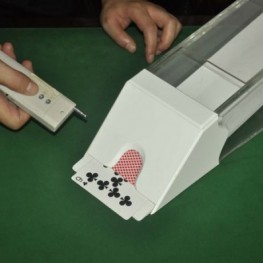
Poker CY Analyzer: Exceptional Gambling Skills? Turns Out to Be Technology!
How Exactly Does This Device Work?
1. The Core Principle: Secretly Capturing Card Information
The device contains a miniature pinhole camera concealed inside everyday objects such as water bottles, watches, and mobile phones. It scans identification codes printed along the edges of playing cards or directly captures images of the card faces.
2. Real-Time Information Transmission to the Cheater
After the card information is captured, the data is sent to a processing unit for analysis. The analyzed results are then transmitted wirelessly to a concealed earpiece worn by the cheater. The earpiece provides audio notifications about card combinations or the predicted outcome of the game.
3. Several Common Types of Devices
Common varieties include single-user poker analyzers, intelligent poker analysis systems, and scanning systems paired with concealed contact lenses. Some devices even claim to be capable of analyzing an entire deck of cards within just 0.3 seconds.
1. How a Poker Analyzer Works: A Cheating Device Disguised as an Everyday Object
The core design concept behind a poker analyzer is to conceal image-capturing technology, data analysis capabilities, and information transmission functions inside ordinary everyday objects. This allows the device to operate discreetly, enabling cheating without attracting attention. Its entire operating process consists of three closely connected stages, all of which can be completed in a fraction of a second. Other players are unlikely to notice anything unusual, and even experienced poker players may have difficulty detecting the device at first glance.
Stage 1: Covert Image Capture
The core component of the device is an extremely small pinhole camera, reportedly even smaller than a grain of rice. Manufacturers conceal these cameras inside everyday objects such as water bottles, watches, mobile phones, power banks, Mahjong table edges, ordinary ballpoint pens, and even men's belt buckles.
Without requiring any modifications to the playing environment, these devices can capture specially printed invisible identification codes along the edges of playing cards or photograph the entire face of a deck of cards while appearing to be in their normal position or being worn naturally.
Many people who use these devices deliberately choose disguised models that look almost identical to ordinary consumer products. Even if someone casually picks up a water bottle to inspect it, the camera module hidden inside may be difficult to detect. Some high-end concealed models are even designed with waterproof capabilities, allowing their internal camera components to remain concealed even if the object is accidentally knocked over or exposed to spilled water.
Stage 2: Real-Time Data Analysis
The images captured by the concealed camera are transmitted through low-power encrypted wireless signals to a paired processing unit. The processing chip inside the main device can reportedly identify, sort, and calculate card combinations within 0.3 seconds.
It can quickly determine each player's hand, calculate the strongest possible moves in the current game, and even provide recommendations on optimal betting, raising, and folding decisions.
Some upgraded models can also work with specially manufactured playing cards containing identification codes. These systems can allegedly be configured in advance to predetermine the dealing sequence, allowing the user to receive the strongest possible card combinations and potentially manipulate the outcome of the entire game.
As a result, the person using the device may gain access to information about other players' hands from the very beginning of the dealing process, giving them an overwhelming advantage and leaving other players with little chance of recovering.
Stage 3: Covert Information Transmission
Rather than displaying the analyzed results on a screen, the system transmits the information wirelessly to a concealed earpiece worn by the user.
The earpiece can deliver information through extremely low-volume audio, including card combinations, opponents' hands, and estimated winning probabilities. Some lower-end versions reportedly use different vibration patterns to communicate information without producing any audible sound.
These earpieces are small enough to fit deep inside the ear canal, making them virtually invisible from the outside. The user only needs to pretend to adjust their hair or touch their ear to check the information, without attracting suspicion.
Experienced users may even be able to maintain a completely natural facial expression throughout the game, making it difficult for other players—even their regular gaming partners—to notice anything unusual.
In 2007, Company launched a range of products, including single-operator poker analyzers, sensor-based dice analyzers, sensor-based mahjong analyzers, fully automatic mahjong analyzers, programmable four-sided mahjong tables, and programmable four-sided dice. In 2008, the company rolled out a series of technologically upgraded products, including programmable four-sided dice, sensor-based dice, programmable mahjong tables, single-operator analyzers, sensor-based mahjong analyzers, and fully automatic mahjong analyzers. Between 2009 and 2010, the single-operator analyzer underwent continuous iteration, reaching its 18th generation.
2002: Advanced technology was imported from the United States and integrated with innovative design concepts, laying the foundation for the independent research, development, and technological upgrading of future gaming equipment.
2004: "Geometric Mahjong" was developed, ushering in a new era of visual identification.
2005: The "Formula Computer Analysis System"—an automated analysis tool—was introduced.
2006: A computer-based scanning analyzer for Mahjong * Domino* (a variant of *Mahjong*) was launched.
2006: "Aviation Ointment" was released, allowing users to manipulate the game while playing, without the need for special eyewear.
2007: "One-Second Mahjong" and "Color-Difference Mahjong" made their debut.
2007: A "Voice-Enabled *Domino* Analyzer" (capable of reading the top layer of tiles) was successfully developed. May 2008: Accelerated development led to the launch of an upgraded, dual-layer "Voice-Assisted *Domino*reader.
June 2008: A backend sensor system for *Domino* was released.
August 2008: A fully automated *Domino* detector made a striking debut...
September 2008: The "One-Second Poker" system was unveiled...
December 2008: The first generation of single-operator systems was introduced.
February 2009: The second and third generations were launched, featuring continuous performance upgrades.
2009: The fourth generation was released, with ongoing performance enhancements and further optimization of recognition capabilities and user experience.
March 2010: The fifth and sixth generations of single-operator poker analyzers made their debut.
June 2010: The ninth and tenth generations of single-operator analyzers were launched, offering simultaneous improvements in recognition performance and user experience.
October 2010: The 13th and 18th generations of single-operator analyzers were introduced.